

Pro Superior Construction is a James Hardie Certified installation company and a fully licensed and insured siding and window specialist serving San Francisco homes, flats and multifamily properties. We hold CSLB License #986607, we have been family owned since 2013, and we back our installations with a 10-year labor warranty in writing. Our crews handle siding installation, siding replacement and targeted siding repair in fiber cement siding, wood, vinyl and LP SmartSide, and we replace windows from manufacturers including Milgard, Andersen, Anlin, Marvin and Pella. The goal on every job is the same: a home’s exterior that sheds water for decades and lifts curb appeal the day the scaffold comes down. Every project starts with a free, no-obligation estimate: a contractor comes out, inspects the exterior and tells you exactly what your home needs.
If you are comparing siding companies right now, start with the basics. In California, any siding contractor performing work valued at more than $500 must hold a license from the Contractors State License Board, and that contractor should carry insurance as well. Ours is public record, and we would rather you check it than take our word for it.
San Francisco adds a second layer: permits. Since February 13, 2026, in-kind siding, window and door replacement applications have been accepted through an online-only process, and we handle that submission as part of our scope so you are not learning a city portal on a weekend.
One call is all it takes to get started. Call (916) 474-4483 or request a free estimate online, and a contractor will inspect your home and assess exactly what it needs. No obligation, no pressure, no pricing guesswork over the phone.
Our Siding Services in San Francisco
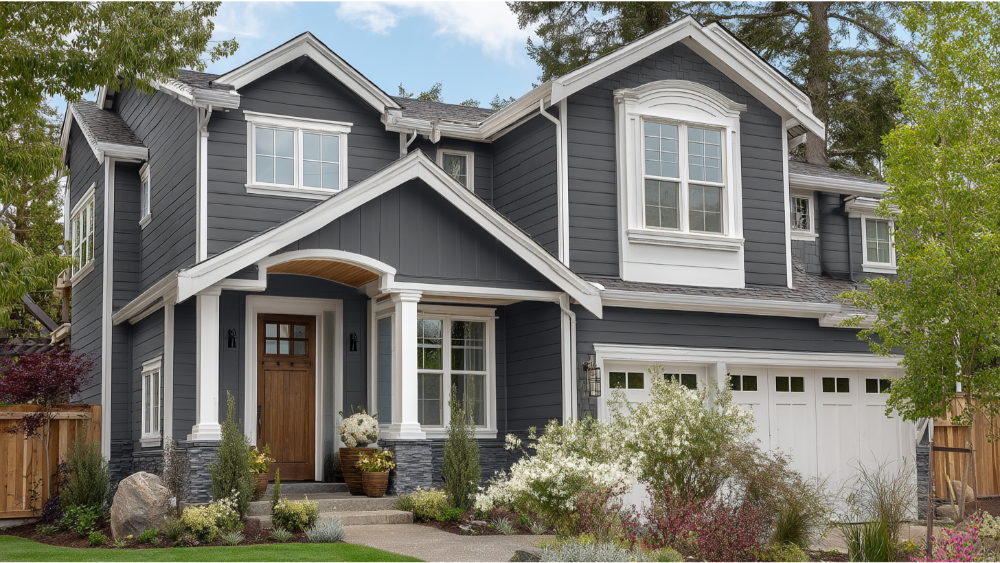
We install, replace and repair exterior siding on San Francisco houses, flats and small apartment buildings, and we replace windows on the same properties. Our work ranges from a single deteriorated elevation to a complete exterior rebuild with new trim, soffit and finish, and we handle exterior painting on site-finished materials when it belongs in the same scope. We are a siding and window specialist, not a handyman service, so we take on partial-elevation and whole-home scopes rather than small patch repairs, and we will tell you honestly at the estimate whether your project is a fit for our crews.
James Hardie Fiber Cement Siding Installation
We are an Elite Preferred James Hardie Certified Installation Company, which means James Hardie has verified that our crews install their products the way the manufacturer requires. That credential is not decorative. It covers approved fastening patterns, required clearances at roofs, decks and grade, corrosion-resistant galvanized or stainless fasteners, and correct handling of end cuts, and the entire crew on your job works to those same requirements. Fiber cement that is beautiful on day one and still sound in year fifteen is almost always a flashing and moisture-management story, so we integrate the water-resistive barrier, window head flashing and kick-out details as part of the installation rather than as an afterthought.
James Hardie siding comes up in most of our San Francisco conversations for a practical reason. It is a durable siding that resists moisture, pests and ignition, it holds a painted finish far longer than most alternatives, and it stays low maintenance beyond a periodic rinse.
The Hardie products you see on San Francisco façades include:
- Hardie Plank Lap Siding for traditional horizontal courses
- Hardie Panel Vertical Siding with Hardie Trim Batten Boards for a board and batten look
- Hardie Shingle Siding for shingled bays and gable accents
- Hardie Trim Boards and Hardie Artisan Trim for corners, casings and belt courses
- Hardie Soffit Panels, vented and non-vented, for eaves and overhangs
- ColorPlus Technology factory-applied finishes, including the Statement and Dream Collection colors
Factory-applied color is one of the simplest ways to significantly enhance your home’s curb appeal without signing up for a repaint cycle every few years.
Classic Wood Siding and Historic Profile Matching
Wood siding still belongs on a large share of San Francisco homes, and we repair and replace it with profile matching rather than a generic substitute. Approximately 45.2% of San Francisco housing units were built before 1940 according to 2020 to 2024 ACS data, and in the documented Hayes Valley historic area, most buildings are wood-frame and date from roughly 1885 to 1910 with Victorian or Edwardian design. On those homes, the siding reveal, the trim profiles and the bay window detailing are the architecture. Replace them with something close-enough and the whole façade reads wrong.
We document existing profiles before we order anything, preserve original trim where it is sound, and mill or source matching material where it is not. Be realistic about upkeep: wood siding needs routine maintenance, repainting and sealing to keep moisture out, and we will tell you what that cycle looks like before you commit to it.
Vinyl Siding and LP SmartSide
Vinyl siding is a legitimate option, and we install it without the sales pitch against it. Its appeal is straightforward: it is one of the more affordable cladding choices, it holds up well, it comes in a wide selection of colors and profiles, and it asks very little of you beyond periodic washing. Insulated vinyl siding adds a foam backing behind the panel, which stiffens it and contributes to energy efficiency on exposed walls.
LP SmartSide engineered wood sits between vinyl and fiber cement. It carries a deeper wood grain and takes paint beautifully, which matters on homes where the texture of the original cladding is part of the character. We will walk you through which siding options make sense for your elevation exposure, your home’s style and your maintenance appetite.
Siding Replacement vs. Targeted Repairs
Targeted repairs are the right call when the damage is contained and the rest of the assembly is sound: cracked boards, water damage at a leaking window head, a failed section of trim, weather damage on one exposed wall. A full replacement is the right call when the underlying water-resistive barrier has failed, when rot has reached the sheathing across multiple areas, or when repeated patching has already cost more than the wall is worth.
Professional siding replacement follows an order that does not change: the old siding comes off, the sheathing gets inspected and repaired, the barrier and flashing go on correctly, and only then does the new siding installation begin on a wall that is actually ready for it.
Two things we say up front. First, a repair needs to cover at least one complete wall to qualify for our warranty, because we can only stand behind an assembly we installed end to end. Second, concealed damage is real. On older homes, what is behind the siding is not knowable until the siding comes off, so our contracts include a written method for handling hidden rot with your approval before any extra work proceeds.
Window Installation and Replacement
We install and replace windows from Milgard, Andersen, Anlin, Marvin, Pella, Alside, Amsco, Lindsay and Plygem, including lines such as Marvin Elevate and Ultimate, Milgard Trinsic and Ultra, Andersen 100 Series and E-Series, Pella Impervia and Anlin Catalina and Del Mar.
Here is the San Francisco detail many pages leave out. A building permit is required for every window replacement in San Francisco, regardless of where the window sits on the building: front, side, rear or light well. Windows visible from a street or other public right-of-way also receive Planning review for architectural compatibility, which can affect frame material, operating type and sash proportions. On a Marina home with original wood-sash windows in stucco openings, or a Sunset row house with a street-facing bay, that review is not a formality.
Do not order windows before approval. Custom units are not returnable, and an approval that comes back requiring a different frame material or configuration turns a deposit into a loss. We confirm the path first, then order.
Exterior Siding for Flats, Small Apartment Buildings and Multifamily
We work on two- and three-unit flats, small apartment buildings and larger multifamily properties, and that experience is the reason our single-family work runs the way it does. Sequencing scaffold around occupied units, protecting entries residents use daily, keeping a wall dry between tear-off and dry-in: those standards were built on buildings where a mistake affects a dozen households, and they carry straight into a two-story house on a 25-foot lot. Every project, residential or multifamily, gets a named project manager you can reach directly.
Fire-Resistant and Ignition-Resistant Siding Options
We install ignition-resistant siding that meets Wildland-Urban Interface (WUI) building standards, and we confirm whether those standards apply to your specific address before specifying materials. Fire hazard designation is address-specific and map-driven, not a neighborhood assumption, so verifying it is part of responsible code compliance rather than an upsell. Fiber cement is noncombustible and carries a strong fire performance record, which is why it comes up often in these conversations. Note the language: fire-resistant and ignition-resistant, never fireproof.
Why San Francisco Homeowners Choose Our Team
Homeowners choose us because every claim on this page is one you can verify before you pick up the phone. CSLB License #986607 is public record. Our James Hardie Certified status comes from the manufacturer, not from us. We have been BBB Accredited with an A+ rating, we were founded in 2013, we are family owned, and our team has completed permitted residential exterior projects in San Francisco.
Expert siding installation is mostly made of details you will never see once the walls are closed up, which is why we specify high quality materials and install them to manufacturer standards instead of to whatever is fastest. We work efficiently, but we do not trade thoroughness for speed, and our competitive pricing comes from running an organized job rather than from thinning out what goes on your house. Customer satisfaction is the finish line we measure against, and an outstanding job is one you stop thinking about for years.
Verify us before you call. Look up #986607 on the CSLB website and confirm the license is active and the business name matches the name that will appear on your contract. In California, a contractor doing work over $500 must be licensed, must carry general liability insurance, and must carry workers’ compensation insurance if the company employs anyone. Siding work in California is generally performed under a C-61/D-41 (Siding and Decking) classification, and you will sometimes see C-45 referenced in contractor directories. Ask for a certificate of insurance. Read reviews, then ask for references on homes similar to yours. The CSLB also recommends getting at least three bids before you hire, and we are comfortable being one of them.
How to Compare the Estimates You Receive
A vague estimate is the single biggest source of cost surprises on an exterior project. A quote with upfront pricing you can actually compare should itemize material and labor separately and spell out:
- Which walls and elevations are included, with wall area
- Tear-off versus installation over existing siding
- Sheathing replacement and dry-rot allowance
- Water-resistive barrier, flashing and window integration
- Trim, soffit, paint and finish work
- Scaffolding, staging, sidewalk protection and debris removal
- Who submits the permit and who schedules inspections
- Material line, profile, color and warranty
- The change-order method if concealed damage is found
- Written exclusions
Also separate the two warranties, because they are not the same thing. A manufacturer warranty covers the product itself against defects. A workmanship warranty covers the installation. Ours is a 10-year labor warranty on our own quality workmanship, in writing: if something goes wrong with our work, we come back and repair it. Ask every bidder for both in writing, and read what voids them.
Will a Company Your Size Care About My House?
We are family owned, and the relationship with our clients is the thing we are most protective of. You get a named project contact, not a ticket number, and that person walks the job with you at completion. Customer service is our highest priority and we pride ourselves on honest, quality work over quick turnarounds. To us, the job isn’t done until the customer is satisfied, which is a different finish line than “the crew packed up.”
That is also our answer to “will you rush my job.” We do not sell speed. We sell an exterior assembly that manages water correctly on a house that may be a century old. Contact us today for a free estimate, or call (916) 474-4483.
How Our Siding Installation Process Works
Our process runs in five stages, and we keep permitting, product lead time and installation on separate clocks so no one is handed a single misleading calendar date. We manage the entire project, permits included, which is what makes this closer to a stress free experience than most home improvement work.
- Free consultation, estimate and on-site exterior inspection. A contractor walks every accessible elevation, checks siding condition, trim, flashing, window integration and visible signs of moisture, and reviews access and staging. You receive a written scope and itemized pricing, at no cost and no obligation.
- Written contract and itemized scope. California requires a detailed written contract for home improvement work, and state law caps the down payment at $1,000 or 10% of the contract price, whichever is less. Your contract names the material line, the elevations, the exclusions, and the change-order method for concealed rot: we photograph it, price it, and you approve it before we proceed.
- Permit submission. We prepare and submit the application. Since February 13, 2026, in-kind siding, window and door replacement applications have been accepted through an online-only process, and we handle it. Launch-period PermitSF data showed a two-business-day median issuance time for the combined in-kind door, window and siding category as of March 12, 2026, which is a useful benchmark rather than a guarantee. Historic review, non-in-kind changes or an incomplete application take longer, and we will tell you which path your project is on.
- Product ordering and installation. Material lead time is its own clock and starts only once approval is in hand. James Hardie notes that installation on an average home typically takes one to two weeks depending on size and repairs. We schedule tear-off and exposed-wall work around reliable dry windows, protect the site and your neighbors’ frontage daily, and keep walls dried-in rather than open overnight.
- Final inspection and closeout walkthrough. Door, siding and window inspections for PermitSF permits are scheduled through the online applicant dashboard, and we request them. A DBI final onsite inspection is required to complete a permitted window replacement. Then we walk the job with you, list anything you want corrected, and correct it.
What Makes a San Francisco Siding Project Different
Four things change how an exterior project is planned here: the age of the housing stock, the permit and design-review structure, lot width and site access, and a marine climate that is unforgiving of poor water detailing.
Older Housing Stock and the Neighborhoods We Work In
Roughly 45.2% of San Francisco housing units were built before 1940, which means most exterior projects here are renovations of assemblies built before modern water-resistive barriers existed. That changes what belongs in an estimate: existing sheathing condition, prior leak damage, original siding profile, irregular window openings, earlier unpermitted alterations, and whether any insulation or weather barrier is present at all.
The building types vary block to block:
- Sunset and Parkside: rows of single-family tract houses built primarily from 1925 to 1950, closely spaced, with façade rhythm that neighbors notice and street-level garages that complicate staging.
- Outer Sunset: the Rousseaus’ Boulevard Tract holds 93 houses built in 1932 and 1933, including early Patio Plan designs, where original façade forms and details should be documented before anything is proposed.
- Marina: documented historic housing includes two- and three-story-over-garage homes with Spanish and Mediterranean influences, stucco, clay tile and wood-sash windows, where arched openings and sash proportions carry the design.
- Hayes Valley and the Western Addition: primarily wood-frame buildings from roughly 1885 to 1910 with Victorian and Edwardian detail, multiple façade bays and substantial ornament.
- Glen Park: hillside grades where scaffold placement and material delivery need to be solved on paper before a schedule means anything.
Check your property’s historic category before you fall in love with a product. Category A* properties, including City Landmarks and properties in certain historic or conservation districts, are not eligible for ordinary over-the-counter window approval and may require a preservation entitlement. Knowing that at the estimate stage costs nothing. Finding out after ordering costs a great deal.
Permits, Planning Review and Who Handles Them
Two agencies are involved, and we deal with both so you do not have to. The San Francisco Department of Building Inspection issues and inspects building permits, while San Francisco Planning reviews exterior design and Planning Code compliance. Most projects fall into one of two paths. Exterior siding repair or replacement can qualify for over-the-counter processing when it is an eligible in-kind project, meaning you are replacing materials rather than changing the façade, the openings or the architectural character.
Change the openings or the architectural expression and the project leaves the in-kind path, which means plans and a longer review. We identify which path your scope falls into during the estimate, in writing, before you sign anything. Since February 13, 2026, in-kind siding, window and door replacement applications go through an online-only process, and our office prepares the application, submits it, and schedules the inspections through the applicant dashboard. Who handles the permit should never be an open question on your contract.
Narrow Lots, Hills and Site Access
Typical San Francisco residential lots are about 25 to 30 feet wide, which means the logistics of reaching your walls belong in the scope before anyone quotes a timeline. A project may involve one accessible rear elevation and a street-facing front with no side access at all. Scaffolding, sidewalk protection, material staging, delivery routes and hillside grade are not afterthoughts here. They are line items.
We assess all of it during the on-site inspection: where scaffold can stand, where material can be staged without blocking a neighbor’s garage, how debris leaves the site, and whether a party wall or light well limits what can be done. Any estimate that quotes your home like a detached house with four open elevations has not actually looked at your lot.
Fog, Winter Rain, Wind and Salt Air: Choosing Durable Siding Materials
San Francisco’s marine climate, with cool dry summers, winter rain, recurring summer fog and strong afternoon sea breezes, makes water management and fastening the specification decisions that matter most. Flashing, a properly lapped water-resistive barrier, sealed end cuts and correct clearances determine whether a wall survives a decade of wind-driven rain. Fog alone does not fail siding; details do, and the best materials on the market will not rescue a wall with bad flashing behind them.
On wind-exposed elevations we use manufacturer-approved fastening patterns and corrosion-resistant hardware. High atmospheric salt content is specifically recognized along the Northeastern Waterfront, so properties with that exposure get closer attention to fastener, flashing and window-frame finish selection. Wood siding in this climate also needs its maintenance cycle respected, and we will tell you what that is rather than let you discover it.
Our San Francisco Service Area
We serve homeowners and multifamily property owners across San Francisco and the wider Bay Area, from the Sunset and Parkside to the Marina, Hayes Valley, Glen Park and the surrounding communities. Our headquarters is in Rocklin, in Placer County, and our service area reaches across the majority of Northern California, including inland communities such as Fair Oaks and Citrus Heights. What makes a crew worth hiring here is not proximity to your block; it is scheduled inspections, a named project manager and local knowledge of the permit path your scope has to follow.
Frequently Asked Questions
What does a siding job cost in San Francisco?
Cost is driven by wall area, how many elevations are accessible, tear-off versus installation over existing siding, concealed rot, material line, trim, paint, scaffolding and permits. That is why we price after an on-site inspection rather than over the phone: a number given blind is a guess, and guesses turn into change orders. Hidden damage behind an older exterior is common here, so our quotes itemize material and labor and state the method for pricing anything found during tear-off. The inspection and the estimate are free and carry no obligation.
Do I need a permit to replace siding, and does every window need one?
How long does siding installation take?
Can you replace just one wall, or does the whole house need new siding?
Can fiber cement match the look of my home’s original wood siding?
Do you serve my San Francisco neighborhood?
Free Siding Estimates in San Francisco
A contractor will inspect your home and assess exactly what it needs, and you will receive an itemized written scope, a clear permit plan and a 10-year labor warranty in writing. Financing options are available. There is no obligation at any point, and no pressure to decide on the spot.
Call (916) 474-4483, Monday through Friday, 9:00 AM to 7:00 PM, or request your free estimate online. We will look at your walls, tell you what we see, and give your home the attention it deserves.


