

Pro Superior Construction installs, replaces, and repairs siding for North Natomas homeowners, with James Hardie fiber cement siding as our flagship. We are a family-owned company founded in 2013, fully licensed and insured under CSLB #986607, and an Elite Preferred James Hardie Certified Installation Company, which means our crews meet the manufacturer’s highest installation standards. If you are deciding who to hire in North Natomas, those two things matter most: a certification that holds us accountable to a strict installation method, and a license that keeps the work compliant with local building rules.
We back our labor with a 10-year warranty. We will come out and repair our work if something goes wrong. That is the kind of commitment you can only make when the job is done right the first time, which is why we prioritize honest, quality work over quick turnarounds. When you are searching for siding contractors near me and comparing bids, that difference shows up years later in a wall that still sheds water cleanly instead of one that quietly fails behind the paint.
Choosing a contractor with a manufacturer certification gives you quality assurance that goes beyond a salesperson’s promise, and a properly licensed installer keeps your project in line with the permit and inspection steps North Natomas requires. We handle both for you. Not every crew advertising exterior siding work carries the paperwork to prove it, and that gap is exactly where homeowners get burned. We put our license number in writing so you never have to wonder.
The first step costs nothing. Call us or request a free, no-obligation on-site inspection, and a contractor will look at your home and tell you exactly what it needs. We offer free siding estimates on every project, from a single cracked board to a complete re-side, because the only way to price exterior siding honestly is to see the house in person.
Our Exterior Siding Services in North Natomas
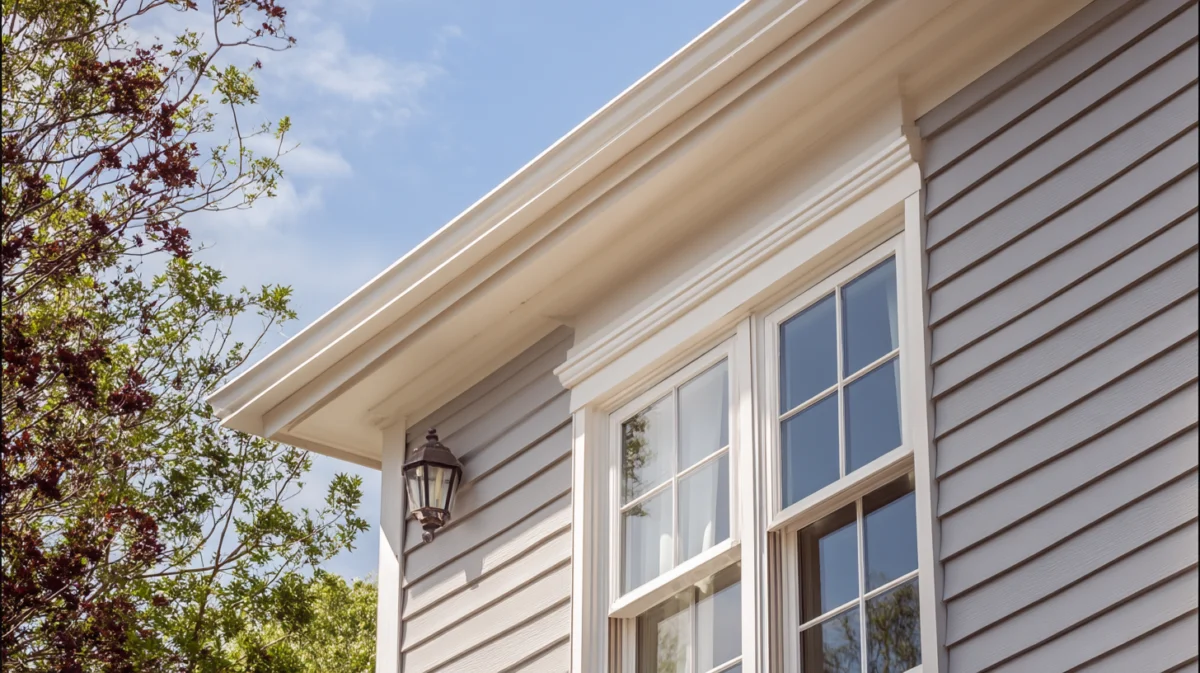
We install and repair siding across North Natomas’s predominantly single-family housing, along with the multifamily properties the community also includes. Every service pairs two things you care about: protection against sun, rain, and winter fog, and the fresh look that lifts your home’s curb appeal. New siding does both jobs at once, which is why so many homeowners treat a re-side as both a maintenance project and a visual upgrade.
Choosing the right material comes down to durability, maintenance, and cost, and we walk you through those trade-offs during your inspection rather than pushing one product. Our siding options cover fiber cement, vinyl, classic wood siding, and engineered wood, and each one fits a different budget and a different look. We also help homeowners weigh alternatives like brick veneer against clad systems when the question comes up. Good siding work is also moisture work: careful flashing and weather barriers behind the cladding are what prevent problems years after installation. The cladding you see is only the outer layer of a system, and the parts you do not see are the parts that decide how long that system lasts. Our siding services range from a single board to a full re-side, and you can read more on our main siding page, or see the options below.
James Hardie Fiber Cement Siding Installation
James Hardie fiber cement siding is our flagship siding for North Natomas homes, and for good reason. Fiber cement is a dense, cement-based board that holds its shape through the valley’s hot, dry summers and cool, wet winters without the swelling, cupping, or warping that can affect other materials. That dimensional stability means low maintenance for you and a finish that keeps looking sharp. Hardie fiber cement siding was engineered for exactly this kind of mixed climate, where a material has to survive both intense summer heat and months of seasonal damp.
North Natomas’s strong summer sun and damp winters can push lesser materials toward dry rot and warping over time. Hardie siding resists both, and its baked-on color technology holds up against fading far longer than field-applied paint on wood. That color stability is a real part of curb appeal, because a wall that keeps its color evenly across every elevation reads as a well-kept home from the street. One more reason James Hardie fiber cement stands out in this region is its Class A fire rating, the highest rating for a building material under standard testing. We install the full James Hardie siding line, including:
- Hardie Plank Lap Siding, the classic horizontal profile that suits the majority of production homes here
- Hardie Panel Vertical Siding for board-and-batten and modern looks
- Hardie Shingle Siding for cottage and craftsman accents
- Hardie Trim Boards to finish corners, windows, and transitions cleanly
- Hardie Soffit Panels, vented and non-vented, to complete the exterior with matching durability overhead
Our Elite Preferred James Hardie certification is not a badge for show. It means our crews install to the manufacturer’s documented method, including the correct fastener spacing, clearances to the ground and roofline, and joint treatment that Hardie specifies. That accountability protects both your warranty and your home, because fiber cement siding installed outside those tolerances can perform poorly no matter how good the product is. The quality siding and the expert siding installation have to arrive together, and the certification is how you know they do. Homeowners choosing Hardie board siding are investing in high quality materials that reward precise work.
Siding Replacement
Full exterior siding replacement gives an aging North Natomas home both weather protection and a new look in one project. Much of the area was built out after the 1994 community plan, which means a large share of homes are now reaching their first major maintenance cycle. Original sealants, paint systems, and builder-grade exterior details that looked fine for years eventually open up, and that is when water finds its way in. A new siding installation at that point does more than cover the old surface; it resets the entire weather envelope of the house.
New siding does more than refresh the exterior. Properly installed cladding with a tight weather barrier seals drafts and improves energy efficiency, so the house holds temperature better through summer heat and winter cold. Homeowners who re-side an older production home often notice the difference in comfort first, because the original builder-grade assembly rarely sealed as tightly as a carefully detailed replacement does. Improving your home’s energy efficiency this way is a quiet benefit that keeps lowering your energy costs on every utility bill. Industry figures put siding replacement somewhere in the range of $4 to $16 per square foot depending on material, which is exactly why a flat quote online means little. Your real number depends on wall area, stories, access, and condition, so we price it after we see the house.
When we replace siding, we replace the whole system the right way across the entire project: cladding, trim, flashing, and the moisture barrier behind it. We do not re-side over a questionable wall and hope for the best. If the sheathing underneath has taken on moisture, the right move is to address it during the replacement while the wall is open, not to seal a problem inside a brand-new exterior. That is the difference between a re-side that lasts and one that looks good for a season and then starts telegraphing trouble through the finish. Whether you need targeted work or a full replacement, we scope it honestly.
Siding Repair and Dry Rot Repair
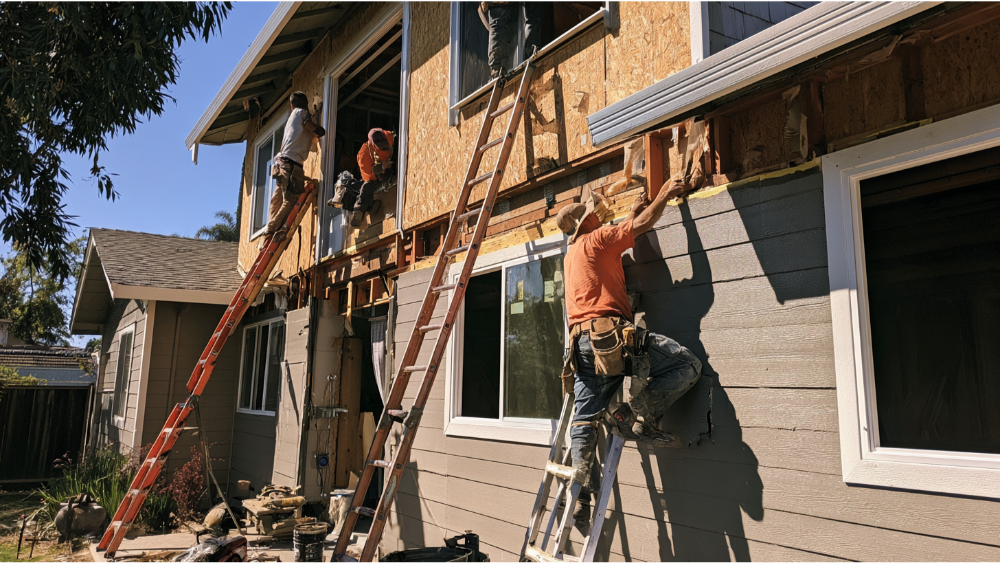
Targeted repairs fix damaged, cracked, dented, or weather-beaten boards before small problems become expensive ones. Not every home needs full replacement, and we start with diagnosis rather than an automatic recommendation to tear everything off. A good siding repair restores both the look and the protection of the wall without the cost of a complete re-side, and for many North Natomas homes that is the smart first step.
Cracked or split siding is more than cosmetic. Once the surface is breached, water works behind the cladding and reaches the sheathing and framing, where it causes dry rot you cannot see from the street. Weather-damaged siding needs prompt attention to keep the wall assembly sound, and timely rot repair prevents the kind of concealed damage that turns a modest job into a major one. The most expensive siding repair is the one that was put off for two winters, because by then the water has usually found the framing.
Common repair triggers we see on area homes include trim that has softened below windows, boards that have taken impact damage near walkways and driveways, and joints where the original caulking has shrunk and pulled away. Each of those is a path for water, and each is far cheaper to correct early. One thing to know up front: to qualify for our labor warranty, a repair needs to cover at least one complete wall. That standard lets us stand behind the whole elevation rather than a single patched board. During the work, if we open up a wall and find dry rot or softened framing hiding underneath, our dry rot repair process documents it and talks it through with you before anything extra proceeds.
Siding Options: Durable Vinyl Siding, Classic Wood, and LP SmartSide
Beyond fiber cement, we also install vinyl siding, classic wood siding, and LP SmartSide for homeowners who want other siding materials. Each has a place depending on budget, look, and maintenance preference, and part of our job during the inspection is helping you weigh them honestly against how you actually live in the home.
- Vinyl siding is low maintenance and can last for decades with little upkeep. It never needs painting, resists moisture well, and quality installation can add real resale value, with some figures citing roughly $15,490 in added home value. Insulated vinyl siding adds a layer of backing that further helps with energy efficiency. For a homeowner who wants durable siding without an ongoing maintenance routine, it is a sensible choice.
- Wood siding delivers a natural, warm look for homeowners who want authentic texture and are willing to maintain it. Classic wood siding has a depth and grain that engineered products imitate but never fully match, and for the right home that character is worth the periodic repainting and sealing it asks for.
- LP SmartSide is an engineered wood product that pairs the appearance of wood with strong durability and a treated surface built to resist moisture and pests. It bridges the gap for homeowners who love the look of real wood siding but want less maintenance than the natural product requires.
We also handle mobile-home siding, which matters here because a mobile-home park was established along El Centro Road before the major 1990s buildout. Those wall assemblies are not the same as standard tract homes, and we treat them accordingly, matching both the fastening approach and the material to how the structure is actually built.
Why North Natomas Homeowners Choose Us
Homeowners choose us because we lead with proof, not promises. Before we talk about siding profiles and colors, we show you the credentials that answer your first two questions: will the work be done right, and can you trust the people doing it. In a field where anyone can print a flyer and call themselves siding contractors, that evidence is what separates a real company from a risk. Customers often tell us our team did an amazing job and remained incredibly respectful of their property throughout, which is the kind of outstanding work we hold ourselves to.
Good contractors carry general liability insurance and workers’ compensation coverage, give you references and past work to inspect, and offer a dual warranty that covers both the manufacturer’s product and their own workmanship. We check every one of those boxes. We also serve projects of every size, from a single damaged wall to full multifamily exteriors, so no North Natomas home is too small for our attention. That range is also a sign of capacity: a company that can manage a large building reliably will not be rattled by a two-story home with mixed materials. A dedicated project manager keeps you informed at each stage, and you can expect excellent customer service from the first call forward. If you want to talk it through, reach out to our team.
Fully Licensed, Insured, and James Hardie Certified
We are fully licensed and insured under CSLB License #986607, and that number is yours to verify. Licensing keeps your project compliant with the permit and inspection steps North Natomas requires, and insurance protects you if anything goes wrong on your property. An unlicensed installer may quote less up front, but that savings disappears the moment a permit is denied or an injury happens on an uninsured job, and the homeowner is the one left holding the risk.
On top of that, we hold Elite Preferred James Hardie certification, the manufacturer’s top installer credential. It confirms our crews install to Hardie’s documented standards rather than improvising, which is the difference between siding that performs for decades and siding that voids its own warranty. Fiber cement siding is only as good as the hands that hang it, and the certification is third-party accountability, so you are not just taking our word for the quality of the work. James Hardie does not hand this credential out lightly, and keeping it means staying current on the method as the product and its install guidelines evolve.
10-Year Labor Warranty and Satisfaction Standard
Your project is covered by two warranties working together: the manufacturer’s coverage on the siding product itself, and our own 10-year labor warranty on the installation. If something happens with our workmanship, we come back and repair it. That written workmanship warranty is the part many homeowners overlook when comparing bids, because a strong product warranty means little if the installation that triggered a leak was never covered in the first place. Our comprehensive warranties are a core reason homeowners feel confident signing with us.
Behind that warranty is a simple belief. To us, the job isn’t done until the customer is satisfied. We pride ourselves on honest, quality work over quick turnarounds, which means we would rather take the time to detail a wall correctly than rush to the next job and leave a problem behind. That standard, backed by genuine quality workmanship, is why we can put a decade of labor coverage in writing. A company that cuts corners cannot afford to offer that, and the warranty length is a quiet promise about how we actually build.
Transparent, Upfront Pricing in Writing
Our written estimate breaks the project into its real parts so you can see exactly what you are paying for. Instead of one lump sum, you get line items for siding, trim, flashing, the weather-resistant barrier, paint or factory finish, disposal, and any sheathing repairs we can anticipate. That detail is also what lets you compare bids honestly, because a lower total that quietly leaves out flashing or tear-off is not the same scope. Upfront pricing is not just a nicety here; it is the only fair way to shop for exterior siding, because the cheapest number on paper is often the one hiding the most.
The estimate is free and carries no obligation. Our pricing is built around competitive value at a fair price, not cutting corners to look cheap. In California, a contractor cannot ask for more than $1,000 or 10 percent of the total project price as a down payment, and we work within that rule. If concealed damage turns up after tear-off, we handle it through a written change order, so there are no surprise charges you never agreed to. For homeowners who want to spread the cost of a larger project, financing options are available, and we can walk you through how that fits your scope during the estimate.
Family-Owned With Large-Project Capacity
We are a family-owned company that treats your project as a relationship, not a transaction. That has been true since 2013, and it is the first thing most of our customers mention. When you call, you are dealing with the same company start to finish, not a rotating cast of subcontractors who have never spoken to each other. Our detail oriented crews bring the same care to a single wall as they do to a full exterior.
At the same time, we run full multifamily exterior projects, which take real systems to manage. North Natomas includes both single-family and multifamily housing, and the same crews and processes that keep a large building on track are what let us handle a two-story, mixed-material home without the job slipping or the communication going quiet. You get the capacity of a serious contractor and the personal attention of a family business, which is a combination that is harder to find than it should be in exterior siding work. As an exterior siding contractor serving the wider region, we bring that standard to every address we work.
How Our North Natomas Siding Installation Process Works
Our process is built to remove the guesswork, from your first call to the final walkthrough. Here is how a North Natomas siding installation moves forward with us, step by step, so you always know what is happening and why.
1. Free on-site inspection and written estimate. A contractor comes to your home, assesses the walls, trim, flashing points, and any signs of moisture or movement, and then gives you a free written estimate. This free consultation carries no obligation. Because North Natomas sits on flat, low-lying ground where soil movement can show up around windows and trim, we photograph any preexisting cracks or displaced details before we quote, so nothing is in dispute later. This is also where we talk through your siding options, because the material you choose affects everything downstream, from the permit path to the final look.
2. Material selection and association documents. We help you choose the siding, profile, and color, and we assemble the product literature, photos, and finish details you may need for a residential association review. If your home is in an association, we ask for your governing documents early so approval does not hold up your schedule. For many homeowners this is the fun part, where curb appeal gets decided, and we bring samples and finish examples so you can see how a color reads in the valley’s bright light rather than guessing from a small chip.
3. Permit. A building permit is required for siding work, and we obtain it for you through the Community Development Department, Building Division. When your project changes the siding material, the permit path includes an Exterior Siding exemption form, which requires a floor plan showing the replacement areas, photographs of the building and existing siding, and photographs or product literature for the proposed siding. We prepare that bundle so the application is complete the first time, which is the single biggest factor in avoiding a review delay.
4. Installation. Our crew removes the old siding, inspects the exposed sheathing, and installs the weather-resistant barrier, flashing, and new cladding with the moisture detailing that keeps water out. Correct flashing and water management around windows and penetrations is the part most buyers never see and the part that matters most through winter rain and fog. We keep the site clean as we go and protect landscaping and walkways, because a tidy job site is part of respecting your home. Most homes are completed in about one to two weeks, though we confirm your schedule after inspection rather than before.
5. Inspection and final walkthrough. Permitted work has to be inspected before it is covered or concealed, and the project is not finished until it receives final acceptance, so we coordinate those inspections at the right stages. Inspection requests submitted before 6:00 p.m. are normally scheduled for the following workday, which helps us keep the job moving. When the work passes and the exterior is cleaned up, we walk the home with you and confirm you are satisfied before we call it done. That walkthrough is where the satisfaction standard becomes real, because we want you looking at a crisp looking exterior and agreeing it was done right. Homeowners regularly tell us we did an excellent job once the last board is on.
North Natomas Siding: Neighborhoods, Housing, and Local Considerations
North Natomas is a young, master-planned community, and that shapes nearly every siding decision here. The area saw its major development after the 1994 community plan was adopted, and the growth was dramatic: the population climbed from 2,321 in 2000 to 55,582 in 2010. The result is a landscape of production homes built in a compressed window, most of them now roughly two decades old and entering their first serious exterior maintenance cycle. When a whole neighborhood goes up in a few short years, it also ages on a similar schedule, which is why so many homeowners here are weighing new siding around the same time.
We work across the officially recognized neighborhoods, including Natomas Creek, Regency Park, Heritage Park, Natomas Park, Westlake, Sundance Lake, Natomas Crossing, and Gateway West. Each has its own character and its own planning considerations:
- Natomas Park is a large master-planned community whose association represents approximately 3,940 homes and about 13,000 residents. On a community that size, knowing who approves exterior changes and which colors are allowed is one of the first things to settle before work begins.
- Regency Park is bounded by West Elkhorn Boulevard, Club Center Drive, Natomas Boulevard, and the municipal boundary. The 41.67-acre Regency Community Park, a joint-use park and detention basin on Honor Parkway, is a landmark residents navigate by.
- Westlake orients around Westlake Parkway, where Egret Park sits as a familiar neighborhood marker.
- Valley View Acres predates the major buildout as a rural-estates community, and those larger properties are not the same scope as the surrounding tract homes.
- The mobile-home park along El Centro Road, also established before the 1990s buildout, calls for a different approach to wall assemblies than standard production housing.
Residential development across the community is predominantly suburban single-family housing with some multifamily housing, so we plan for everything from compact two-story production homes to larger buildings. Many of these production homes share the same builder-grade exterior details, which means the same weak points tend to show up across a street, and we know where to look. Major corridors that frame the area, including West Elkhorn Boulevard, North Natomas Boulevard, Club Center Drive, Del Paso Road, Arena Boulevard, Truxel Road, and San Juan Road, are how most residents orient their neighborhoods, and they help our crews plan access, staging, and neighboring-property clearance on two-story jobs where lots sit close together.
Climate drives the material conversation here. North Natomas has hot, dry summers and cool, moist winters, with tule fog possible in the valley. That combination of strong sun and seasonal damp is what pushes some older exterior materials toward dry rot and warping, and it is why finish quality, color stability, compatible sealants, and correct flashing all carry real weight. Fiber cement siding earns its place in this climate on dimensional stability and lasting protection, not on any wildfire claim, because North Natomas is not a confirmed wildfire-exposure area. The sun that fades a cheap finish in a few summers is the same sun a baked-on color system is built to shrug off, and the fog that softens untreated wood is the same moisture a correctly detailed fiber cement wall sheds without complaint. We match the material to how the valley actually behaves across the year.
The Permit Process and the Building Division
A building permit is required for siding work in North Natomas, and we obtain it for you through the Community Development Department, Building Division. You do not have to learn the forms or stand in line; handling the permit is part of the service, and it is one of the main reasons homeowners hire a licensed company instead of a handyman for exterior siding.
The residential siding application bundle includes separate forms depending on your project: a path for like-for-like replacement, a path for material changes, and a path for historic properties. When you are changing the siding material, the project runs through the Exterior Siding exemption application, which requires a floor plan showing the replacement areas, photos of the building and existing siding, and photos or literature for the proposed product. The exemption form posted July 13, 2026 lists a $132 planning-review fee.
The building-permit charge is separate and valuation-based, calculated on the building official’s figure or the contract amount, whichever is higher, and it may include additional plan-review and technology charges. Because that portion depends on your scope and declared valuation, we confirm it against your specific project rather than quoting a flat number. Note that siding work in California generally must comply with local permit requirements, and material changes in particular trigger the review above. Once work is underway, it must be inspected before it is covered or concealed and must pass final acceptance, and we schedule those checkpoints so the job stays on track. Getting the paperwork right the first time is the quiet skill that keeps a project moving, and after more than a decade of pulling these permits we know what the Building Division wants to see.
Association Approval and Flood-Zone Review
Two local questions come up often, and both have calm, specific answers. For associations, we plan ahead rather than react. In a community like Natomas Park, with its roughly 3,940 homes, exterior changes often need review, so we ask for your governing documents early and prepare the color information, product literature, photos, and elevation details you can submit. Many associations keep an approved palette, and a material like Hardie siding with its factory color technology makes it straightforward to match or complement what the community already allows. We cannot promise approval, because the association makes that decision, but we make sure your submission is complete and professional.
On flooding, the Natomas Basin is designated an A99 Special Flood Hazard Area, which sounds more alarming than it is for a typical siding job. The flood-related rules effective July 1, 2024 apply to new construction and projects classified as substantial improvement or substantial damage, not to routine siding replacement. The Building Division determines whether those requirements apply to your specific scope, so if anything about your project could cross that threshold, we flag it and let the department make the call. For the vast majority of re-sides, a new siding installation simply replaces the exterior skin of the home and never comes near that threshold.
Frequently Asked Questions
Do I need a permit to replace siding in North Natomas, and who pulls it?
Yes, a building permit is required for siding work, and we obtain it for you. We file through the Community Development Department, Building Division. The residential siding application bundle includes separate forms for like-for-like work, material changes, and historic properties, so we match your project to the right path. If you are changing the siding material, that means the material-change form with its required plans and product photos, which we prepare as part of the service. Handling the permit is included in what we do, so you never have to navigate the Building Division on your own.
What is the average cost of a siding job, and how much for a 1,500 to 3,000 sq ft house?
How long will siding replacement take on a two-story North Natomas home?
Can you repair one damaged wall instead of a full replacement of the whole house?
What happens if you find damaged sheathing after removing the old siding?
Which siding material is best for a North Natomas home?
Will the A99 flood zone or my HOA affect a normal siding replacement?
Get Your Free Siding Estimate in North Natomas
If your siding shows swollen or loose boards, open seams, soft trim below windows, or paint that keeps failing over the same problem, those are the signs worth acting on. The same is true if you have a window replacement planned that could coordinate with new flashing, an association notice in hand, or a sale coming where exterior condition could become an inspection issue. New siding at the right moment protects the home and lifts its curb appeal in the same project, and catching the problem early almost always costs less than waiting.
The next step is simple and costs nothing. Call us at (916) 474-4483 or request a free, no-obligation estimate through our online form, and a contractor will inspect your home and assess exactly what it needs. We are proud to serve North Natomas homeowners alongside the Bay Area and the wider Northern California region, including communities in Placer County, El Dorado County, and nearby cities like Elk Grove, Fair Oaks, and Folsom, and we bring the same certified standard and transparent pricing to every job, large or small. No pressure, just a clear written plan from a licensed, James Hardie certified, family-owned team. Contact us today and let’s get your North Natomas home protected and looking its best.


