

Pro Superior Construction installs, replaces, and repairs siding for Sun City Lincoln Hills homes, and we handle window replacement that ties into your existing exterior. We are a licensed, family owned siding specialist carrying CSLB License #986607 and James Hardie Elite Preferred certification, with more than 10 years of work behind us since 2013. That manufacturer credential matters because it signals we are trained to James Hardie’s own installation standards, and that is the kind of proof you want when you choose among siding contractors. When homeowners here start calling around for siding installation, the first thing they are really trying to figure out is whether a company will do the work right and stand behind it. Our answer is written into our credentials, not just our promises.
From our Rocklin headquarters, our team knows this community’s two-track reality: exterior changes go through the Architectural Review Committee, and the City of Lincoln requires a building permit for siding. We work within both so your project matches the original elevation and clears approval without surprises. That local knowledge is part of what you are hiring when you bring us in for a siding project, because the paperwork and the craftsmanship both have to be right for the finished result to last and to pass review. Homeowners searching for siding contractors near me in this part of Placer County get a team that already understands the local approval tracks.
The first step is easy and costs nothing. We come to your home, inspect the exterior in person, and give you a free, no-obligation estimate built around what your house actually needs. We offer free siding estimates for every service on this page, whether you need a single accent wall addressed or a full exterior siding plan. Call us at (916) 474-4483 or request your free estimate online whenever you’re ready.
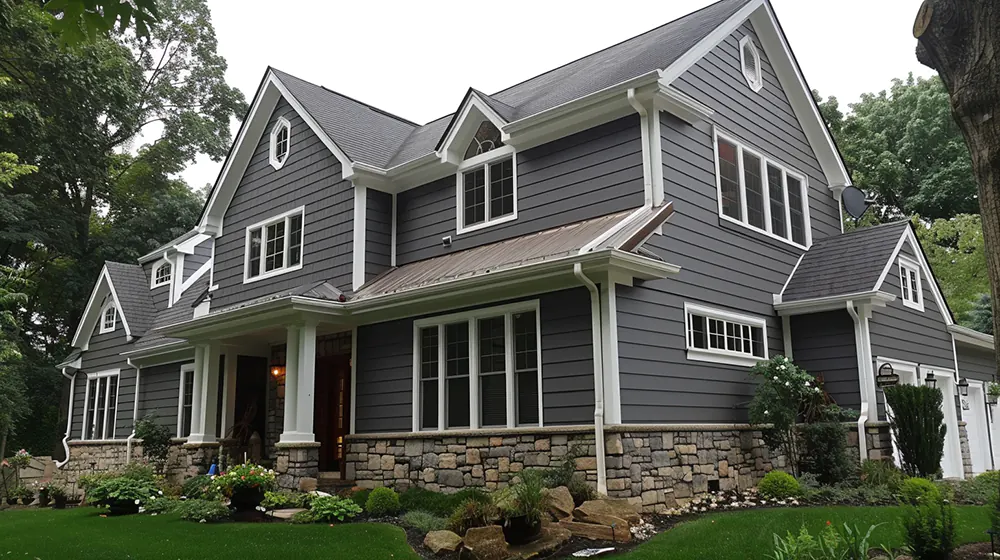
Exterior Siding Services for Sun City Lincoln Hills Homes
We work with the exterior mix this community was actually built with, not a generic tract of full-wall lap siding. Homes here combine stucco, stone or brick veneer, and varied wood siding, so most projects involve individual walls, gables, trim, and accents rather than wrapping an entire house. Good siding does more than refresh how your home looks. It seals out water that causes structural rot, mold, and pest damage, and it tightens the exterior envelope against drafts for better energy efficiency. We pair that protection with a finished look that keeps your home’s curb appeal intact, because the right exterior siding should protect the structure and lift the way the house reads from the street at the same time.
Every one of our siding services is shaped by the same two questions a careful homeowner asks: will it hold up, and will it look right. The January 2026 community guidelines require exterior alterations to conform to the original home’s style, details, materials, and current color unless the committee approves an alternative. Every service below is delivered with that standard in mind, and every one is covered by our comprehensive warranties. You can read more about our full approach on our main siding service page.
James Hardie Fiber Cement Siding Installation
James Hardie fiber cement siding gives Sun City Lincoln Hills homes a durable, finished exterior that stands up to sun and moisture while holding a clean, consistent look. Fiber cement is a cement-and-wood-fiber composite that resists rot and insects better than natural wood, which matters in this climate. James Hardie fiber cement siding also resists warping and cracking under the heat and UV load that the local summers put on an exterior, and it will not feed termites the way untreated wood can. Many profiles also carry a Class A fire rating, which is worth knowing in a region where wildfire is a real consideration. Where the Architectural Review Committee approves it, Hardie® products can serve as a harmonizing substitute that matches the proportions and color relationships of your original elevation.
Our Elite Preferred certification is the reason this matters to you: it means James Hardie has verified that our crews meet the manufacturer’s highest installation standards, and it backs your project with both a manufacturer warranty on the product and our own workmanship warranty on the labor. A certification like this tells you the installer was trained specifically for the product going on your home. James Hardie siding also comes in a wide range of profiles, from Hardie® Plank lap siding to Hardie® Shingle and vertical panel, so a James Hardie siding plan can echo the textures already present across your village rather than forcing a single uniform look. This expert siding installation is backed by high quality materials, and when homeowners ask us about new siding that holds its color and resists moisture for the long run, Hardie board siding is usually the material we walk them through first.
Wood Siding Replacement and Accent Repair
We replace varied wood siding on individual walls, gables, and architectural accents so the repair blends into your original elevation instead of standing out as a patch. Many homes here lean on classic wood siding details at gables, dormers, and entry features, and those are exactly the spots where a mismatched board or a hurried fix shows the most. Because the City’s current design criteria list a Very Heavy termite designation for this area, wood siding and trim deserve a close look before any scope is set.
Wood that is cracked, soft, or showing surface damage often has concealed problems behind it. During every inspection we check for dry rot and structural deterioration in the sheathing and framing underneath, because quality siding only protects the home when what sits behind it is sound. Catching that early prevents the kind of water, mold, and pest damage that turns a small accent repair into a major one. When we take on wood siding replacement, we match grain, exposure, and profile so the new boards disappear into the original design. Where it helps the home’s long-term performance and the committee agrees, we can discuss reducing exposed wood with an approved substitute material that keeps the classic wood siding character while cutting the maintenance and termite exposure that comes with natural wood.
Siding Repair and Dry Rot Repair
We handle targeted repairs, cracked or damaged siding, and failed joints before they let water in behind your exterior. Cracked siding is more than a cosmetic issue. Once water gets behind a board or through an open joint, it reaches sheathing and framing, and a small repair you ignore this year becomes a structural repair later. Our inspection checks for dry rot and concealed deterioration before we finalize scope, so we address the cause and not just the surface. When rot repair is needed, we replace the compromised sheathing and framing before any new board goes on.
A good siding repair also has to match. We correct the failing section and blend it into the surrounding wall so the finished exterior reads as one surface, not a bandage. One policy to know up front: siding repair work must include at least one full wall to qualify for our 10-year labor warranty. That keeps the coverage meaningful and the fix complete rather than a spot patch that fails again in a season or two. If the damage is widespread enough that repair stops making sense, we will tell you honestly and walk you through siding replacement or a full replacement instead, so your money goes toward a result that lasts.

Vinyl Siding, LP SmartSide, and Other Durable Siding Materials
Beyond James Hardie, we install insulated vinyl siding and LP SmartSide engineered wood where they fit the home and the approval process. Vinyl siding is a low maintenance option that is easy to repair and clean, which appeals to homeowners who want minimal upkeep and a durable siding surface that shrugs off routine weather. LP SmartSide is an engineered wood product that holds up well and takes finish nicely, and it gives you the look of real wood siding with better resistance to the termite pressure this area is known for. Material selection here should always account for the local climate: heat, UV exposure, and the Very Heavy termite designation all affect how long siding materials last and how they perform.
Choosing durable siding is not about picking the toughest product in a catalog. It is about matching the material to your elevation, your sun exposure, and what the Architectural Review Committee will approve. We walk you through which of these siding options suits your home, so the choice balances durability with a look that matches the community. Whether you lean toward Hardie fiber cement siding, vinyl siding, or an engineered wood that mimics classic wood siding, we lay out the trade-offs plainly before you commit.
Window Replacement Coordinated with Siding and Flashing
We install and replace windows and integrate them properly with your existing stucco, siding, trim, and flashing. We work with Milgard, Andersen, Anlin, Marvin, Pella, and other trusted brands, so you have real choices in frame, glass, and style. The detail that protects your home is what happens around the opening: proper flashing and a sealed water-management layer prevent the leaks that cause most exterior failures. Done right, a window swap also seals the drafts that drive up heating and cooling costs, which is a direct boost to your home’s energy efficiency when paired with new siding. On high-sun elevations, we help you choose heat-conscious glass and frames that cut solar gain without compromising how the window looks from the street, so the upgrade supports both lower energy costs and curb appeal.
Fire-Resistant / Ignition-Resistant Siding Options
Wildfire is a real concern in this region, and we take it seriously without overstating it. We do not claim the entire community sits in one fire-hazard category, because it doesn’t. The City of Lincoln publishes a property-level Fire Hazard Severity Zone map and directs residents to check their individual addresses. If your property falls within a designated fire-hazard area, we can discuss ignition-resistant siding options and the installation details that apply to your home. Fiber cement siding is a common choice in these conversations, since many profiles carry a Class A fire rating and it does not ignite the way wood siding can, which lets you add a layer of protection while keeping an exterior that still fits the neighborhood. The goal is practical protection that still fits the community’s architectural standards, so you are not choosing between safety and how your home looks.
Why Sun City Lincoln Hills Homeowners Choose Us
Homeowners here hire us because we lead with proof, not promises. We are fully licensed and insured under CSLB License #986607, James Hardie Elite Preferred certified, founded in 2013 with more than 10 years of experience, and BBB A+ accredited. Verifying a contractor’s license status is the single most important step you can take before signing anything, and ours is easy to check. In California, a contractor must carry general liability insurance and workers’ compensation, and any home improvement project over $500 legally requires a licensed contractor. We meet those requirements, and a licensed contractor is also the one who keeps your project compliant with local building codes.
What separates us from a generic siding page is that we genuinely understand this community’s dual-approval reality. Exterior alterations go through the Architectural Review Committee, and the January 2026 guidelines require work to match the original home’s style, details, materials, and current color unless a substitute is approved. A contractor who ignores that leaves you to sort out a rejection or a stop-work problem on your own. We build approval into the process from day one, which is one of the clearest differences between us and siding contractors who only do the install and hand you the paperwork fight. The homeowners who call us an exterior siding contractor they would recommend usually point to exactly this.
We are family owned, and we treat your project as a relationship rather than a transaction. Our experience on larger multifamily work is not a pitch for commercial jobs here. It is simply proof that our crews and our standards hold up on complex, high-volume projects, and that same care carries into a single home in your village. We bring that same discipline to homes across the broader Bay Area and the wider Northern California region, and it shows up in the small details of every siding installation we complete. You can see the full picture on our main siding service page.

Licensed, Insured, and James Hardie Elite Preferred Certified
We carry CSLB License #986607 and are fully licensed and insured, with the D-41 siding classification that California siding work calls for. James Hardie Elite Preferred certification is a manufacturer-backed credential, not a self-awarded badge. It means James Hardie has verified our crews install to the company’s highest standards, which protects both the product warranty and the finished result. We were founded in 2013, so you are hiring a team with more than 10 years of real projects, and we hold a BBB A+ accreditation. Choosing a contractor with a manufacturer certification is one of the clearest ways to buy quality assurance, because the certification tells you the installer was trained for the exact James Hardie siding product going on your walls rather than learning it on your job.
We Know the Community’s Approval and Permit Tracks
We handle both the association and the City, which is where many projects stall when the contractor only knows one. Exterior alterations in Sun City Lincoln Hills are reviewed by the community’s Architectural Review Committee, and separately, the City of Lincoln expressly lists siding as work requiring a building permit. Those are two different approvals with two different sets of expectations. We match the original elevation so the committee has an easy yes, and when you want a material change, your project manager prepares the samples and technical documentation to pursue approval for it. On the City side, we pull the required siding permit and keep the work compliant with local building codes. You should not have to become an expert in either process. That is our job, and it is one of the main reasons homeowners here choose us for siding installation over a crew that only knows how to hang boards.
Fair Pricing and Our 10-Year Labor Warranty
Every siding installation we complete carries a 10-year labor warranty, and if something related to our workmanship fails in that window, we come back and repair it. A strong contractor gives you two layers of coverage: the manufacturer warranty that protects against material defects, and a workmanship warranty that covers installation errors. We provide both comprehensive warranties, and we are clear about what each covers so you understand the exclusions rather than discovering them later.
Upfront pricing is part of the same promise. Your written estimate spells out the scope, the materials, and who handles cleanup, so the number you see is a fair price tied to the work we described, with no vague line items. We also offer financing options for homeowners who want to spread the cost of a larger project. For siding repair, the work must include at least one full wall to qualify for the labor warranty, which keeps the coverage honest and the fix complete. Underneath all of it is a simple standard we hold to: the job isn’t done until you’re satisfied.
How Our Siding Installation Process Works
Our process is a clear five-step path from your first call to a finished, inspected job, built to respect this community’s approval reality so the timeline stays honest. We give you a detailed written estimate that spells out scope and cleanup responsibility, we inspect for dry rot and concealed damage before anything is final, and we encourage you to compare written estimates from any siding contractors you consider. Here is how it runs.
Step 1: Free Consultation and On-Site Inspection
We start with a physical inspection and a free consultation, not a price over the phone. Because development here broke ground in 1999, many homes now have exteriors old enough to hide problems, so our estimator looks closely at flashing, trim, sealants, sheathing, and any concealed deterioration behind the existing siding. Checking for dry rot and structural issues at this stage is what keeps a scope accurate instead of optimistic. You leave with a detailed written estimate that states the project scope and who handles cleanup, with no obligation attached. This is also where we flag whether a targeted siding repair will do the job or whether a wider siding replacement is the smarter long-term call.
Step 2: Material, Color, and Written Scope
Next we help you choose material and color that match your home’s original elevation, since the January 2026 guidelines require alterations to conform to the original style, details, materials, and current color unless a substitute is approved. This is the stage where you decide between matching the old siding, stepping up to Hardie fiber cement siding, or choosing another durable siding material that fits your exposure and budget. Your written scope covers preparation, flashing, trim, finish, cleanup, and warranty, so nothing is left to assumption. If you want a material change, this is where we assemble what the committee will need to see it.
Step 3: Architectural Review and City Permit
We prepare the Architectural Review Committee documentation and pull the required City of Lincoln siding permit. Exterior alterations are reviewed by the community’s committee, and the City expressly lists siding as permitted work, so both tracks apply. The permit office is the City of Lincoln Community Development Department, Building Division and Permit Center, at 600 6th Street in Lincoln. Siding replacement normally requires a building permit from the local authority, and you should be cautious of any contractor who offers to skip it, because unpermitted work can surface later as a problem when you sell.
Step 4: Installation and Water Management
Our crews install with the water-management details that prevent most siding failures: correct flashing, housewrap integration, sealed penetrations, and the expansion clearances the material needs. This is where our quality-over-speed standard shows, and it is why homeowners describe the result as quality workmanship. We take the time to get the layering and transitions right, because the parts you never see are what keep water out of the wall for the long run. Whether the job is a new siding installation across several elevations or a focused repair on one wall, the same water-management discipline applies across the entire project, since that is what separates siding that lasts from siding that fails early.
Step 5: City Inspection and Final Documentation
Every permitted project requires at least one City inspection, and we schedule it. The City’s frame-stage guidance expects siding to be installed and penetrations sealed for that inspection, which is exactly how we work. Where the association requires final photos or documentation, we provide it, and we close with a walk-through so you confirm the result meets the standard we promised. That final walk-through is where our satisfaction standard becomes concrete: we want you looking at the finished exterior and agreeing the siding project is done right before we call it complete.
Siding in Sun City Lincoln Hills: Homes, Climate, and Local Requirements
This is a planned community of 44 principal villages, subdivided into 78 Neighborhood Watch designations, and we serve homes across all of them. Residents orient by major corridors like Sun City Boulevard, Del Webb Boulevard, Stoneridge Boulevard, Spring Valley Parkway, East Joiner Parkway, Ferrari Ranch Road, and Twelve Bridges Drive, and by landmarks such as Orchard Creek Lodge at 965 Orchard Creek Lane. Our headquarters sits in Rocklin at 4130 Citrus Ave., Suite 17, close enough to be your local contractor without being inside the community.
The Villages We Serve
We serve homes throughout the 44 numbered villages, wherever your property sits. Sun City Lincoln Hills does not use conventional named neighborhoods the way many communities do. Instead, residents identify their location by village number and by the corridors that run through the community: Sun City Boulevard, Del Webb Boulevard, Stoneridge Boulevard, Spring Valley Parkway, East Joiner Parkway, Ferrari Ranch Road, and Twelve Bridges Drive. Whether your home sits near Stoneridge Boulevard, one of the villages around Orchard Creek Lodge at 965 Orchard Creek Lane, or closer to Kilaga Springs Lodge at 1167 Sun City Boulevard, we work the same way and hold the same standard. We don’t make assumptions about your village’s style. We inspect your specific home and build the siding plan around that elevation.
The Housing Stock and Exterior Materials Here
As of 2020 the community had 6,783 homes, including 6,703 single-family houses and 80 condominiums, with construction beginning in 1999. Public floor-plan archives document more than 40 plans ranging from roughly 901 to 3,068 square feet, so homes vary in size and exterior detail across the villages. The original primary exterior materials are stucco wall surfaces, stone or brick veneer, and varied wood siding. That mix is why most work here is not a full re-side. It is wood siding on specific walls, gables and trim, siding accents, and repairs tied to individual elevations.
Because many homes are now a couple of decades old, inspecting for dry rot and concealed structural issues before setting scope matters more than it would on a new build. Those years also mean a lot of original wood siding is reaching the point where new siding pays off, both in protection and in a crisp looking exterior, since fresh boards and a correct finish can improve curb appeal on a two-decade-old elevation and make it read as cared-for again. We approach each house as a set of elevations to protect and match, not a blank box to wrap.
Climate, Sun, and Termite Factors That Affect Your Home’s Energy Efficiency
The local climate shapes every material and detail we recommend. City planning documents report an average July maximum near 97°F and about 22 inches of annual precipitation at Lincoln Regional Airport, and the current City design criteria place the area in Climate Zone 11 with a Very Heavy termite designation and a 1.5 inch per hour design rainfall rate. Heat and strong UV argue for UV-stable finishes and factory-applied color where it fits the approved design, along with proper expansion clearances so boards move without stressing joints. This is one of the practical reasons Hardie fiber cement siding comes up so often here, since it holds factory color well and does not swell and shrink with moisture the way natural wood siding can.
The termite designation makes close inspection of wood siding, trim, and concealed substrate a priority, since choosing the right material can reduce exposed wood in an approved exterior. The rainfall figure is why flashing detail and sealed penetrations matter even in a dry-summer region: when it does rain hard, the wall has to shed it. Material selection, water management, and structural inspection together are how quality siding keeps out the moisture, mold, and pest problems a home faces here. The same choices that protect the structure also support your home’s energy efficiency, because a tight, well-sealed exterior keeps conditioned air inside where you paid for it and holds your energy costs down.
Golf-Course, Open-Space, and Corner Lots
Lot exposure changes what holds up best, and the community’s own architectural application sorts homes into categories like golf-course, open-space, interior, and corner lots. Open spaces within Sun City Lincoln Hills are maintained by the community association rather than the City, so many homes back onto landscaped corridors, preserved areas, or fairways. A golf-course or open-space elevation often takes more direct sun and weather exposure than an interior lot tucked between neighbors, which can mean faster coating and sealant wear on the exposed faces. On those elevations, a more durable siding material like fiber cement often earns its keep, because the faces that take the most punishment are the ones that fail first on a cheaper product. We factor your lot’s exposure into material, finish, and color choices so the elevations that take the most weather are specified to last, while the whole home still reads as one consistent exterior.
Fire-Hazard Designations Are Checked Property by Property
We check fire hazard at the parcel level, not with a blanket claim about the community. The City of Lincoln provides a property-level Fire Hazard Severity Zone map and directs residents to look up their individual address, because designations vary from parcel to parcel. For your home specifically, we confirm what the City’s map shows and, if your property falls within a designated fire-hazard area, we discuss ignition-resistant siding options and the installation details that apply. Fiber cement siding is one of the materials that fits this conversation well, since many profiles carry a Class A fire rating that resists ignition while still matching the community’s look. That keeps the conversation honest and tied to your actual property rather than a generalization that may not fit your lot.
Permits and Fees With the City of Lincoln
Siding work requires a City of Lincoln building permit, and we pull it for you. The permit is issued through the City of Lincoln Community Development Department, Building Division and Permit Center, at 600 6th Street in Lincoln. Fees here are valuation-based rather than a single flat siding charge, which means the City calculates them from your project’s value and any applicable review items after it reviews the application. We cannot quote the exact permit total in advance because only the City sets it, but we prepare the application so it is accurate and complete. For projects that require plan check, the City’s general guidance is a two-to-six-week window depending on complexity, and a licensed contractor is the one who keeps the submitted work compliant with the applicable building codes. We build this timing into your schedule honestly rather than promising a review period the City does not guarantee.
Based in Rocklin, Local to Your Village
Our Rocklin headquarters at 4130 Citrus Ave., Suite 17 gives our team direct access to Sun City Lincoln Hills, right here in Placer County. The normal approach runs north on CA-65 through the Twelve Bridges corridor, then into the community by way of East Joiner Parkway, Del Webb Boulevard, Sun City Boulevard, or Stoneridge Boulevard depending on your village. We don’t claim an office inside the community, because that would not be true. We are simply close enough to show up, inspect in person, and manage your siding project without the overhead of a distant contractor. James Hardie siding is also available through local distribution in Lincoln, so sourcing approved product for your project stays within easy reach while we rely on our established trade channels for the full package of trim, flashing, and accessories a quality install needs. That same proximity lets us serve homeowners across the wider region, including the Bay Area and nearby communities like Fair Oaks and Elk Grove, with the same hands-on standard we hold here.
Frequently Asked Questions
What is the average cost of a siding job in Sun City Lincoln Hills?
There is no published average, because cost here depends on your specific home. The price is driven by how many elevations are involved, how much of the house is stucco versus siding, removal and disposal, trim and soffit scope, any sheathing or framing repairs we find, window integration, your material and finish choice, and the permit and approval requirements. A Hardie fiber cement siding plan will price differently than a vinyl siding or a matched wood siding repair, which is one more reason a real inspection beats a phone quote. Published national ranges exist for siding generally, but they don’t reflect this community’s stucco-and-accent pattern or your home’s condition. That is why we come out, inspect in person, and give you a written, project-specific estimate that states the full scope. We encourage you to compare detailed written estimates before deciding, and under California rules a home improvement down payment is capped at the lesser of $1,000 or 10% of the total.
Does the City of Lincoln require a permit for siding replacement?
Do I need Architectural Review Committee approval before replacing siding?
Can I replace wood siding accents with James Hardie fiber cement?
How long will approvals and installation take?
Can you replace siding on just one wall, and will you inspect for dry rot?
Get Your Free Sun City Lincoln Hills Siding Estimate
If your joints are opening up, water is finding its way behind the exterior, a high-sun elevation has faded or started to chalk, or you are getting the home ready to sell, now is a sensible time to act. Small exterior problems don’t stay small, and the sooner we inspect, the more options you have, whether that turns out to be a focused siding repair or a full new siding installation. Our past customers point to our excellent customer service and the fact that our crews are incredibly respectful and detail oriented on site, which is the kind of outstanding work that earns a recommendation.
The first step costs nothing and commits you to nothing. We come to your home, inspect the exterior in person, and give you a written, project-specific estimate, so you know exactly what your house needs before you decide anything. This is an inspection, not a sales call, and our free siding estimates are always no-obligation. Homeowners across Placer County, El Dorado County, and the wider Northern California region call us when they want an excellent job done right the first time.
From our Rocklin headquarters, we reach your village easily and manage your siding project from approval through final inspection. Call us at (916) 474-4483 or reach out through our contact page to request your free estimate. Your home is in good hands, and we’d be glad to show you why.


